

17 Sep, 2026
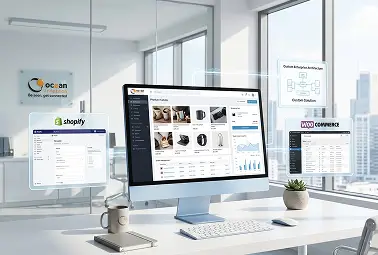
Shopify vs WooCommerce vs Custom E-commerce
#Automation
#DevOps
#Technology2026
#ITIndustry
Post By : Ocean Infotech
Published : 29-08-2026
1. AI Is Becoming Part of the Development Process
.webp)
★ Software development is changing faster than ever.
Businesses are moving toward cloud-based systems, AI-powered development, low-code platforms, progressive web applications, and flexible software architectures. These technologies are not simply changing the tools developers use—they are changing how software is planned, developed, deployed, and maintained.
For businesses investing in software today, understanding these trends can help them make better technology decisions and build solutions that remain useful as their requirements evolve.
★ Here are five important software development trends shaping the industry.
2. Low-Code and No-Code Development Are Expanding
★ Artificial Intelligence is no longer limited to customer-facing chatbots and recommendation systems.
AI is increasingly being used inside the software development workflow to help developers plan, code, test, debug, and deploy applications.
AI-powered development tools can assist with:
✔ Project planning and risk identification
✔ Code generation and suggestions
✔ Code reviews and optimization
✔ Bug detection
✔ Automated testing
✔ Deployment workflows
This doesn't mean developers are becoming unnecessary.
Instead, AI can handle repetitive tasks while developers spend more time on architecture, problem-solving, business requirements, security, and complex development decisions. Your source specifically notes that AI tools are expected to become widely adopted among developers while supporting rather than simply replacing their work.
The takeaway:
★ The future isn't developers versus AI. It's developers who know how to work effectively with AI.
3. Cloud Computing Is Becoming the Foundation of Modern Software
★ Not every business application needs to be developed completely from scratch.
Low-code and no-code platforms allow users and development teams to create applications using visual interfaces, pre-built components, templates, and automation tools.
These platforms can help businesses:
✔ Build applications faster
✔ Automate repetitive processes
✔ Reduce development time
✔ Create internal business tools
✔ Quickly test new ideas
However, low-code and no-code don't eliminate the need for professional developers.
Complex business requirements, integrations, security, scalability, and customized functionality still require technical expertise.
★ The biggest opportunity is therefore not replacing developers, but allowing them to spend more time on complex and high-value solutions.
4. Progressive Web Apps Are Bridging Websites and Applications
.webp)
★ Cloud technology has changed how businesses build and use software.
Instead of depending entirely on local infrastructure, organizations can use cloud platforms to access applications and resources from almost anywhere.
Cloud-based development provides businesses with:
✔ Greater accessibility
✔ Flexible infrastructure
✔ Easier scalability
✔ Support for distributed teams
✔ Faster deployment
✔ Continuous monitoring and improvement
Cloud technologies also work closely with modern DevOps practices, helping teams automate development and operational processes while reducing manual work and errors.
★ For growing businesses, cloud architecture can provide the flexibility needed to scale technology alongside business growth.
5. Microservices Are Making Large Applications More Flexible
★ Users want fast digital experiences, but they don't always want to download another application.
This is one reason Progressive Web Apps (PWAs) are becoming an interesting alternative.
PWAs combine characteristics of websites and mobile applications.
They can provide features such as:
✔ Fast loading
✔ Push notifications
✔ Offline functionality
✔ App-like experiences
✔ Cross-platform accessibility
Because PWAs can work across different device types without requiring completely separate versions, they can also reduce development and maintenance effort in certain use cases.
★ For businesses that need a strong digital experience without forcing customers to install a traditional mobile application, PWAs can be worth considering.
What Do These Trends Mean for Businesses?
★ Traditional software applications were often built as one large system, commonly called a monolithic architecture.
Modern businesses increasingly use microservices architecture, where an application is divided into smaller services, with each service handling a specific business function.
For example, an application might have separate services for:
✔ Customer management
✔ Payments
✔ Inventory
✔ Notifications
✔ Authentication
These services can communicate through APIs and can be developed, deployed, and scaled independently.
Faster development: Smaller components can be developed independently.
Better scalability: Individual services can be scaled according to demand.
Greater flexibility: Different technologies can be used where appropriate.
Improved resilience: Problems in one service can have less impact on the entire application.
★ For large and growing platforms, this architecture can make long-term development and maintenance more manageable.
The Future of Software Development Is About Adaptability
.webp)
★ These technologies have one thing in common:
Software is becoming more flexible, intelligent, scalable, and automated.
Businesses no longer need to think about software as something that is built once and left unchanged.
Modern applications can continuously evolve with:
✔ AI capabilities
✔ Cloud infrastructure
✔ Automated workflows
✔ Modular architectures
✔ Cross-platform experiences
✔ Low-code development
✔ Progressive web technologies
The important question isn't simply "Which technology is trending?"
★ "Which technology actually solves our business problem?"
A technology should be selected according to your business requirements, users, budget, scalability needs, security requirements, and long-term strategy.
★ Software development will continue to evolve.
AI will make development workflows more intelligent. Cloud platforms will continue to provide scalable infrastructure. Low-code tools will accelerate application creation. PWAs will provide new ways to deliver digital experiences, while microservices will help large applications remain flexible.
But technology alone doesn't guarantee a successful software project.
The real advantage comes from choosing the right technology for the right business problem.
At Ocean Infotech, we help businesses evaluate their requirements and develop software solutions that are practical, scalable, and aligned with their business goals.
★ Because the best software isn't necessarily the software using the newest technology.
It's the software that solves the right problem in the right way.
Fillter
Latest News

_5.webp)


Comments