

17 Sep, 2026
Shopify vs WooCommerce vs Custom E-commerce
#EnterpriseAI
#CloudComputing
#DigitalTransformation
#CloudSecurity
Post By : Ocean Infotech
Published : 22-05-2026
The Enterprise AI Problem: Why Most AI Projects Never Reach Production
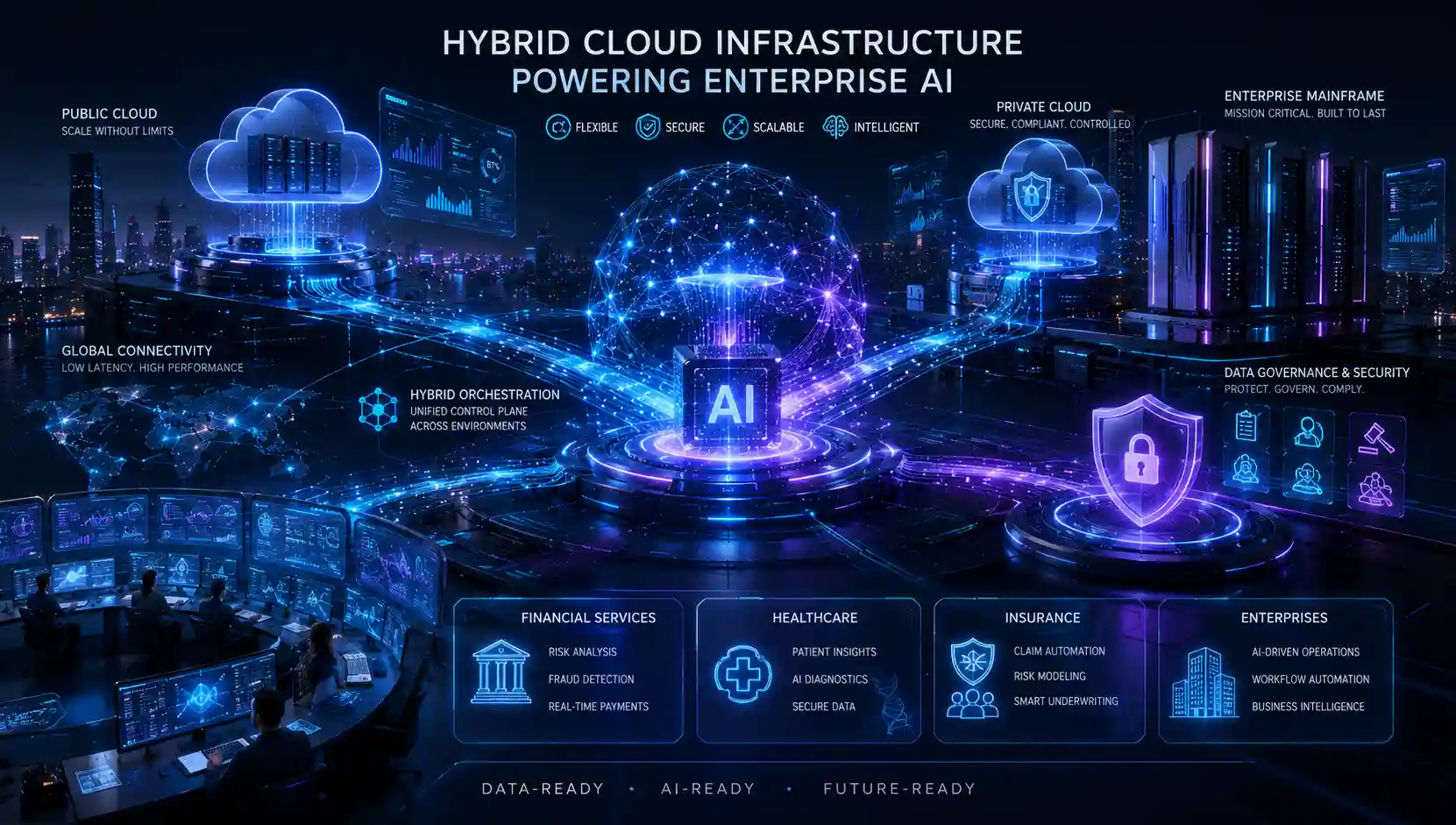
Why Hybrid Cloud Infrastructure is Becoming the Foundation of Enterprise AI Success in 2026
Artificial Intelligence is evolving faster than ever, but one major challenge continues to slow enterprises worldwide: turning AI experiments into real production success.
After years of AI pilots, proof-of-concepts, and large investments in generative AI, many organizations are still struggling to scale AI efficiently across business operations.
★ The real issue is no longer access to AI models — it is infrastructure readiness.
★ Modern enterprise AI success depends on:
● Flexible hybrid cloud infrastructure
● Unified data architecture
● Strong AI governance
● Secure cloud environments
● Scalable computing systems
This shift became a major discussion point at global technology conferences in 2026, where industry leaders highlighted that the future of enterprise AI will be built on hybrid cloud ecosystems.
★ In this blog, we explore:
● Why hybrid cloud is critical for AI scalability
● How enterprises are modernizing infrastructure
● The future of intelligent business operations
AI Sovereignty and Infrastructure Control
Many companies have invested heavily in advanced AI technologies to modernize business operations and improve productivity.
★ Major investments include:
● Generative AI tools
● AI copilots
● Machine learning systems
● Large language models (LLMs)
● AI automation platforms
However, despite massive excitement around AI, only a small percentage of AI initiatives successfully move into full-scale production environments.
★ The biggest challenge is not AI capability — it is infrastructure readiness.
★ Most organizations still lack:
● AI-ready infrastructure
● Unified enterprise data systems
● Scalable cloud architecture
● Proper governance frameworks
● Real-time operational integration
Modern enterprises now operate across multiple environments, making infrastructure management increasingly complex.
★ Enterprise environments commonly include:
● Public cloud
● Private cloud
● On-premise infrastructure
● Mainframe systems
● Edge computing environments
This creates fragmented ecosystems where enterprise data and AI workloads are distributed across multiple disconnected systems.
★ The solution increasingly lies in Hybrid Cloud Infrastructure.
The Future of Enterprise AI Infrastructure
One of the biggest concerns for enterprises adopting AI is maintaining sovereignty and operational control over critical business systems.
★ Organizations want to ensure:
● Control over enterprise data
● Compliance with regulations
● Transparency in AI operations
● Secure infrastructure environments
As AI adoption grows rapidly, businesses are becoming more focused on protecting sensitive information while maintaining full visibility into AI-driven operations.
★ AI sovereignty has become especially important for:
● Government organizations
● Financial institutions
● Healthcare providers
● Global enterprises
These sectors require strict governance, stronger infrastructure security, and better control over how enterprise AI systems are deployed and managed.
★ Modern sovereign AI environments allow organizations to maintain operational control while still leveraging advanced AI capabilities.
Key Benefits of Hybrid Cloud for Enterprise AI

Enterprise AI infrastructure is evolving rapidly as businesses prepare for the next generation of intelligent and scalable digital operations.
★ The future of AI infrastructure will focus on:
● Hybrid cloud scalability
● Intelligent automation
● AI-ready data architecture
● Autonomous operations
● Real-time governance
● Secure sovereign AI systems
Businesses are now investing in flexible infrastructure models that can support both current AI workloads and future innovation demands.
★ Organizations with modern infrastructure will be better prepared for:
● Rapid AI evolution
● Changing regulations
● Emerging AI business models
● Future computational demands
Modern enterprises can no longer treat infrastructure as a secondary technology component.
★ Infrastructure is now becoming a direct driver of enterprise AI growth, scalability, and long-term business success.
Final Thoughts
★ Faster AI Deployment
Hybrid cloud environments accelerate production-ready AI implementation by providing flexible infrastructure and scalable computing resources.
★ Better Data Management
Unified cloud architecture improves enterprise data accessibility, centralized storage management, and governance efficiency.
★ Improved Security and Compliance
Organizations maintain stronger control over sensitive business data while meeting industry regulations and compliance standards.
★ Flexible AI Scalability
AI workloads can move dynamically across cloud, on-premise, and hybrid environments based on performance and operational needs.
★ Lower Operational Risk
Enterprises reduce dependency on a single vendor or infrastructure platform, improving operational flexibility and long-term stability.
The AI revolution is no longer only about foundation models or generative AI tools. The real competitive advantage now lies in infrastructure readiness.
★ Hybrid cloud infrastructure is becoming the essential foundation for:
● Enterprise AI scalability
● Data governance
● AI security
● Operational flexibility
● Intelligent business transformation
Organizations that modernize their infrastructure today will be better prepared to deploy AI successfully at enterprise scale in the future.
As AI adoption continues to accelerate globally, businesses are increasingly prioritizing secure, flexible, and scalable hybrid cloud ecosystems.
★ The future of enterprise AI belongs to organizations with flexible, secure, and data-ready hybrid cloud architectures.
Fillter
Latest News



_5.webp)


Comments