

17 Sep, 2026
Shopify vs WooCommerce vs Custom E-commerce
#CustomEcommerce
#EcommerceIndia
#DigitalCommerce
#EcommerceGrowth
Post By : Ocean Infotech
Published : 17-09-2026
Platform Comparison
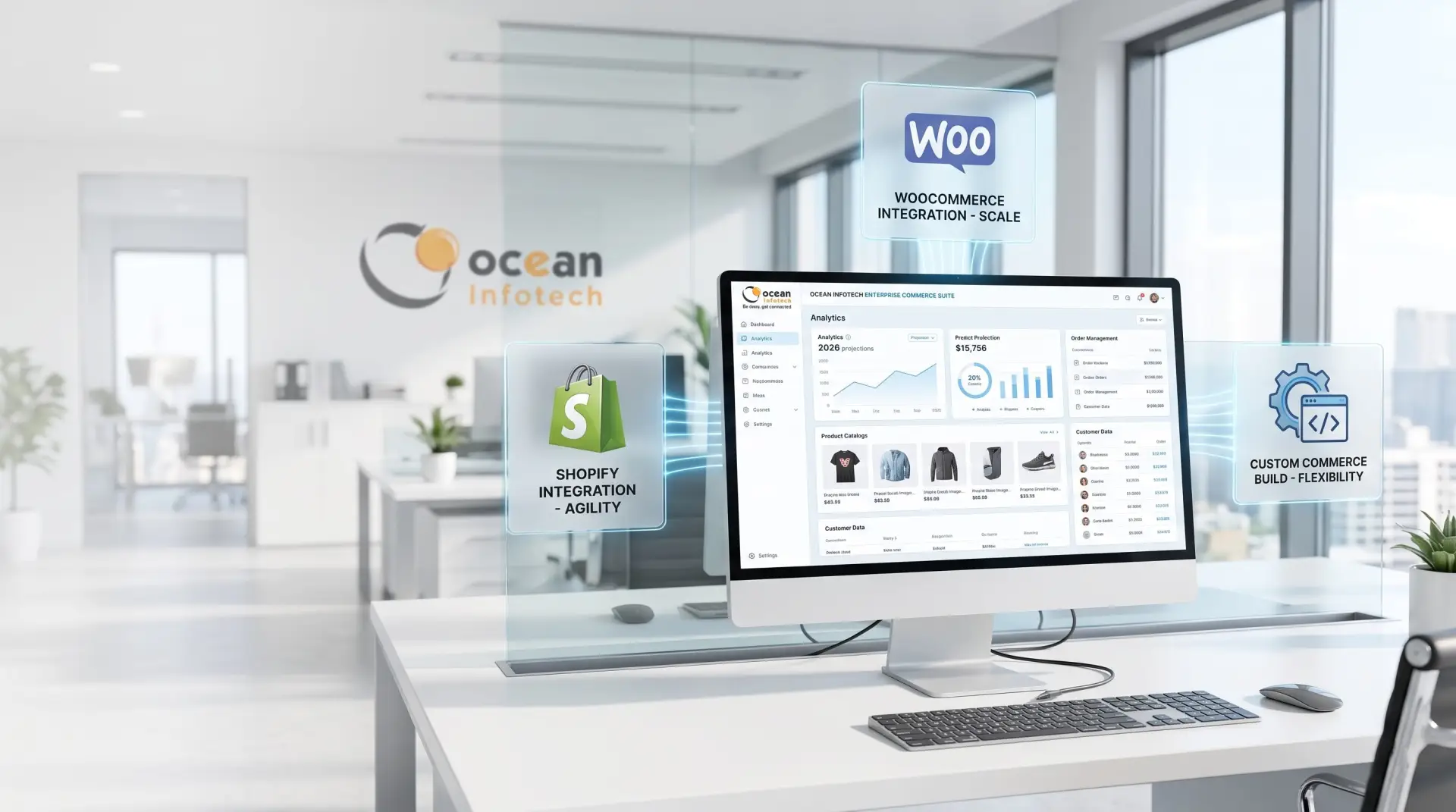
Choosing the right e-commerce platform is a business and technology decision. It affects speed, checkout, payments, SEO, inventory, customer data, integrations and scalability.
For many businesses, the choice comes down to Shopify, WooCommerce or a custom e-commerce application. The best option depends on your business model, technical requirements, integrations, growth plans and required level of control.
Quick answer: Shopify is usually strongest for fast launch and managed infrastructure. WooCommerce is attractive when WordPress, content and hosting control matter. Custom e-commerce is best considered when complex workflows, B2B requirements or deep integrations exceed what standard platforms can efficiently support.
Shopify: Speed & Managed Infrastructure
| Factor | Shopify | WooCommerce | Custom |
|---|---|---|---|
| Launch | Very fast | Fast–moderate | Moderate–long |
| Hosting | Managed | Self-managed | Fully controlled |
| Database | Platform-controlled | High control | Complete control |
| Customization | High | Very high | Maximum |
| Maintenance | Low infrastructure work | Regular maintenance | Full responsibility |
| Integrations | Apps/APIs | Plugins/APIs | Fully bespoke |
| Best fit | D2C & growing stores | Content + commerce | Complex business models |
WooCommerce: Flexibility & WordPress Control
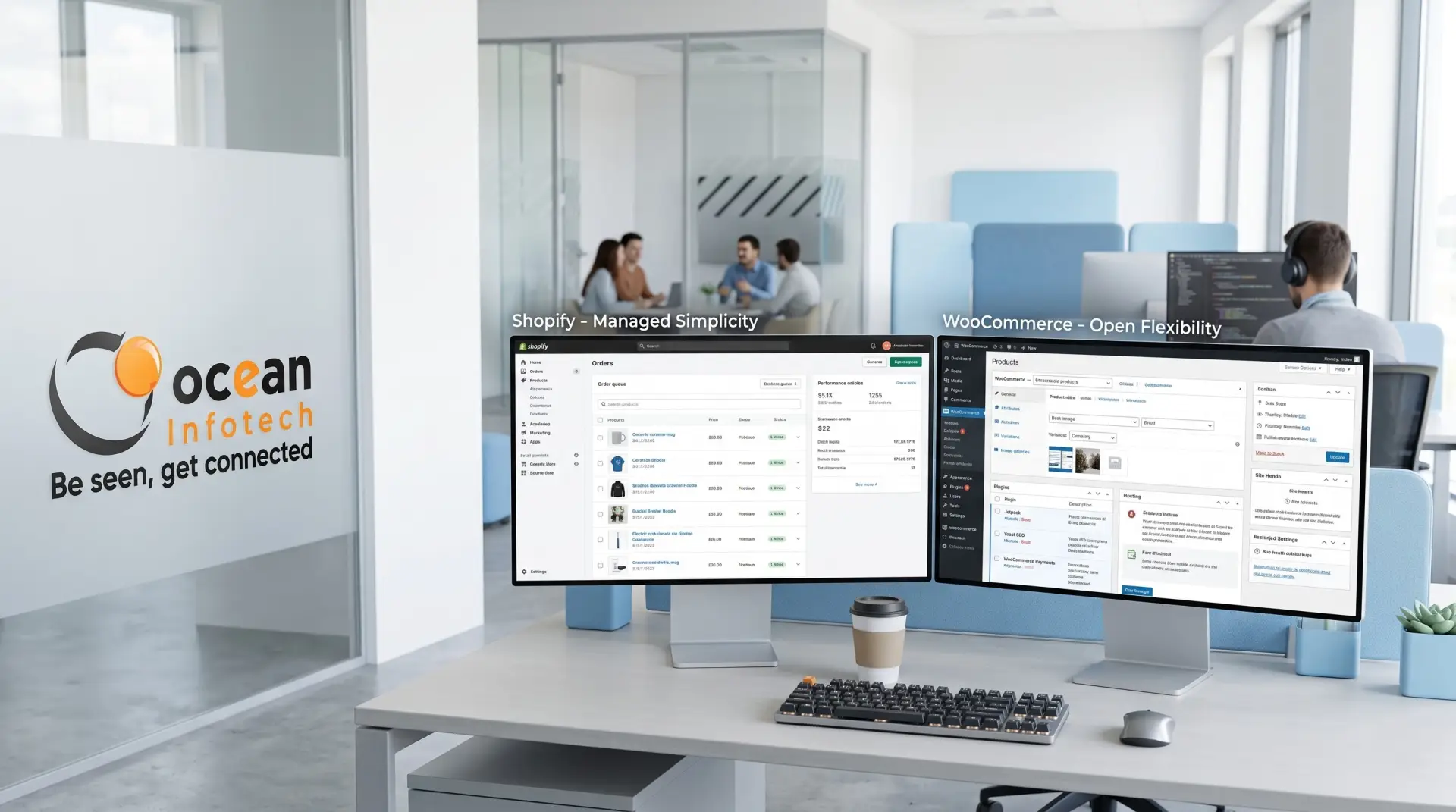
Shopify is a hosted e-commerce platform designed to simplify online-store operations. It is attractive to startups, D2C brands, retailers, fashion and beauty businesses, and companies moving from offline to online.
Faster deployment and a mature commerce foundation.
- Managed infrastructure reduces day-to-day server administration.
- Large ecosystem of themes, apps and integrations.
Can connect with CRM, ERP, inventory, payments, shipping and marketing systems through supported apps, APIs and custom development.
Considerations: platform-specific limitations, app dependency, recurring platform/app expenses, checkout constraints depending on requirements and plan, and dependency on the Shopify ecosystem.
The key question is not whether Shopify is good; it is whether Shopify supports the way your business actually operates.
Custom E-commerce Development
WooCommerce is an e-commerce platform built around WordPress. It is attractive to businesses that want greater control over website content, hosting, database and extensions.
Strong WordPress and content-marketing integration.
- Flexible product structures and custom functionality.
- Large extension ecosystem.
Suitable for businesses that want more control over their hosting environment.
Maintenance matters: self-hosted stores need ongoing attention to WordPress, WooCommerce and plugin updates, security, backups, database optimization, server configuration, performance and compatibility.
Adding too many poorly maintained plugins can create performance, security and compatibility problems.
When Custom Development Makes Sense
Custom e-commerce means designing the storefront, backend, business logic and integrations around the organization's specific workflow.
It can be useful for manufacturers, distributors and B2B businesses that need different prices, discounts, customer permissions, credit terms, approval workflows, inventory allocation or multi-location operations.
SEO, Performance & Conversion

Complex B2B pricing or customer-specific pricing.
- Multi-location or multi-warehouse inventory.
- Complex product configuration or ordering workflows.
- Deep CRM or ERP integration.
Custom subscriptions, marketplace functionality or advanced customer portals.
Highly customized checkout or customer journeys.
Important: custom does not automatically mean better. A poorly built custom store can perform worse than a well-optimized Shopify or WooCommerce implementation.
Key SEO factors
All three approaches can support strong e-commerce SEO. Rankings are influenced by technical implementation, content, site architecture, performance, authority and user experience—not simply by the platform name.
E-commerce + CRM + ERP: Build a Connected System
Crawlability and indexability
- Mobile usability and Core Web Vitals
- Product/category architecture and internal linking
- Canonical URLs, XML sitemap and redirects
- Structured data and useful product content
- Image, JavaScript, CSS and caching optimization
- Checkout usability, trust signals and clear shipping information
Shopify: strong foundation, but themes, apps, URLs, metadata and performance still need careful management.
WooCommerce: extensive SEO flexibility, especially with WordPress content, but hosting and plugin quality can affect performance.
Custom: maximum architectural control, but SEO quality depends entirely on implementation.
Questions Before You Decide

An online store should not always operate as an isolated system. Connecting commerce with CRM, ERP, inventory, shipping and marketing can improve visibility and reduce duplicate manual work.
CRM Integration
Customer information can flow from the store into a CRM, where profiles, order history and follow-up workflows can be managed. This becomes especially valuable when a business sells through multiple channels.
ERP Integration
Depending on the architecture, ERP integration can synchronize products, inventory, orders, customers, prices, warehouses, shipping and purchasing information.
Mobile Applications
Growing businesses may also connect Android, iOS, Flutter or other mobile applications to the same backend systems, supporting accounts, product browsing, notifications, order tracking, loyalty and customer support.
Which Platform Should You Choose?
✔ Choose Shopify if you want a fast launch, managed infrastructure, standard commerce capabilities and a broad app ecosystem.
✔ Choose WooCommerce if WordPress/content marketing, hosting control and flexible customization are important.
✔ Consider Custom if your business has complex workflows, deep CRM/ERP requirements, unusual pricing, multiple warehouses, advanced B2B needs or a highly customized customer journey.
Ocean Infotech: E-commerce Development & Integration
How quickly must we launch?
- How complex is our workflow?
- How much technical control do we need?
Which CRM, ERP, payment, shipping and marketing systems must integrate?
How complex is our inventory?
- How important is content marketing?
- Where do we expect the business to be in 3–5 years?
Final Verdict
Ocean Infotech helps businesses build, customize and connect digital commerce systems.
- Shopify: store development, theme customization, custom storefronts, APIs, third-party integrations and performance optimization.
- WooCommerce: store development, custom functionality, plugin integration, custom plugin development, performance optimization and APIs.
- Custom e-commerce: custom web applications, B2B e-commerce, customer portals, custom checkout workflows, inventory systems, multi-vendor platforms and dashboards.
- Business integration: CRM, ERP, inventory management, payment gateways, shipping platforms, marketing systems, third-party APIs and mobile applications
Shopify is a strong choice for speed, convenience and managed infrastructure. WooCommerce is strong for WordPress integration, open-source flexibility and hosting control. Custom e-commerce is appropriate when complex processes and integrations require deeper architectural control.
The best platform is not the one with the longest feature list. It is the one that fits your business today while providing a realistic path to scale tomorrow.
Need help choosing between Shopify, WooCommerce and custom e-commerce development? Talk to Ocean Infotech about your requirements and get an architecture recommendation based on your business needs.
Fillter
Latest News


_5.webp)


Comments